Wireless vs Wired Smart Home: Which Choice for Your Project?
Reliability, security, costs, interference: this guide objectively compares wireless technologies (Zigbee, Z-Wave, KNX RF) to wired KNX to help you make the best choice for your situation.
Wireless or Wired: A Strategic Choice
The choice between wireless smart home and wired is not a matter of fashion but of context. New build or renovation, required reliability level, initial budget and total cost over 15-20 years: each criterion points to a different solution.
This guide presents an objective analysis of the advantages and disadvantages of each technology to enable you to make an informed choice.
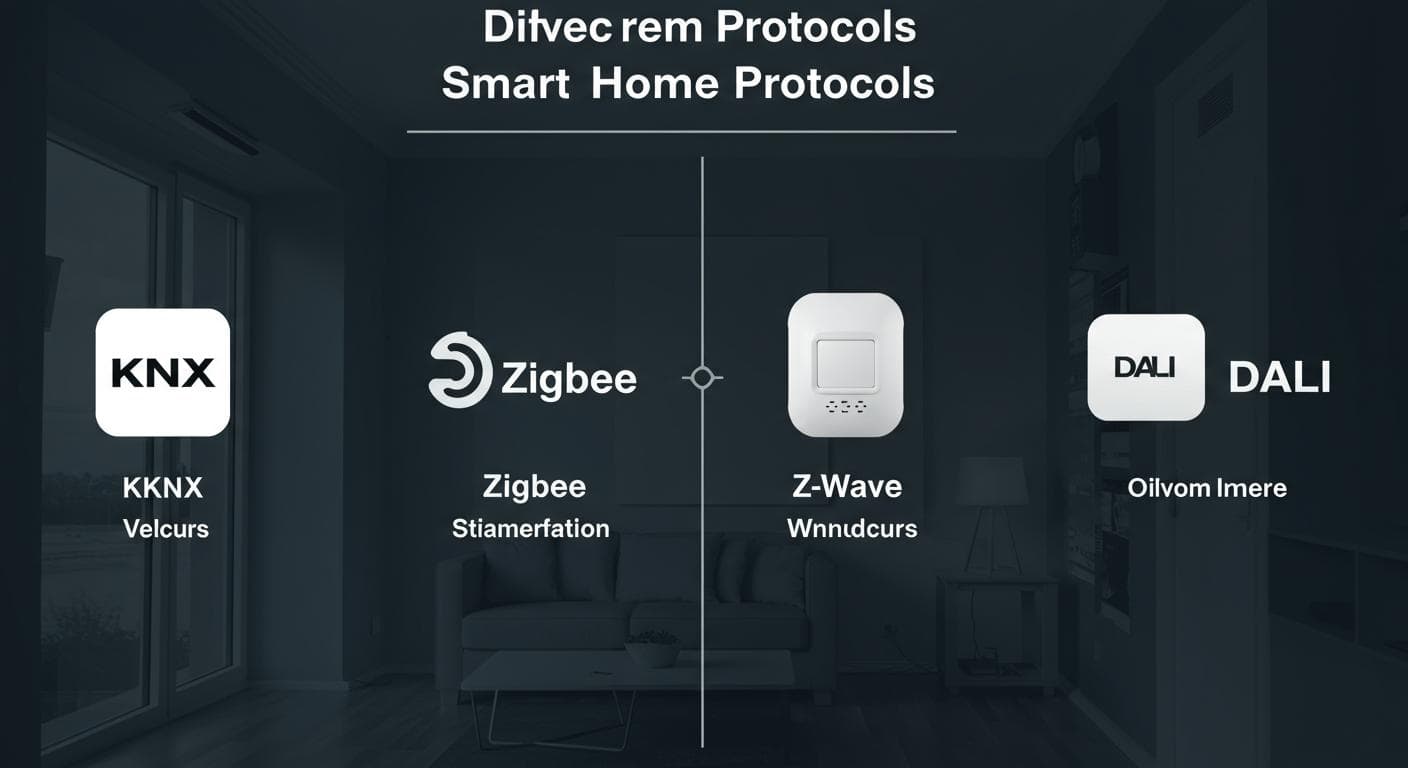
Wireless Technologies
Zigbee
Low-power mesh network
- • Range: 10-30m indoor
- • Frequency: 2.4 GHz
- • Mesh: yes (self-healing)
- • Brands: Philips Hue, IKEA
Z-Wave
Dedicated smart home protocol
- • Range: 15-30m indoor
- • Frequency: 868 MHz (Europe)
- • Mesh: yes
- • Brands: Fibaro, Aeotec
WiFi
Direct internet connection
- • Range: 20-50m
- • Frequency: 2.4/5 GHz
- • Mesh: via mesh router
- • Brands: Shelly, TP-Link
KNX RF
Professional KNX wireless
- • Range: 30-100m
- • Frequency: 868 MHz
- • Compatible with wired KNX
- • Brands: all KNX manufacturers
Wired KNX: The Professional Reference
KNX Bus (Twisted Pair)
Dedicated low-voltage cable (29V) carrying data and power. Global standard for 30 years, compatible between 500+ manufacturers.
- • Reliability: >99.9%, no interference
- • Security: Encrypted data (KNX Secure)
- • Lifespan: 20-30 years minimum
- • Latency: <20ms (real time)
Detailed Comparison
Wireless vs Wired: Comparison Table
| Criterion | Wireless | Wired KNX |
|---|---|---|
| Reliability | 95-99% | >99.9% |
| Interference | Possible | None |
| Renovation installation | Simple | Complex |
| New build installation | Simple | Optimal |
| Initial cost | -30 to -50% | Reference |
| 15-year cost (TCO) | Variable | Stable |
| Batteries | Yes (2-5 years) | No |
| Lifespan | 5-10 years | 20-30 years |
| Scalability | Good | Excellent |
Advantages of Wireless Smart Home
Ideal for renovation: no chasing, no cables to pull. Installation in a few hours.
30 to 50% cheaper to install than an equivalent wired system.
Sensors and actuators can be positioned anywhere, easily movable.
Adding new equipment over time without heavy intervention.
Disadvantages of Wireless Smart Home
Neighbour's WiFi, microwaves, cordless phones can disrupt communication (especially at 2.4 GHz).
Thick walls (concrete, stone) drastically reduce range. Often requires repeaters.
Battery-powered sensors: replacement every 2-5 years, recurring costs and maintenance.
Electronic components: 5-10 years vs 20-30 years for wired. Faster obsolescence.
Some protocols poorly secured. Higher hacking risk than wired.
When to Choose Wireless?
Wireless is recommended if:
- ✓ Renovation with no cabling possibility
- ✓ Rental (removable equipment)
- ✓ Limited initial budget
- ✓ Test before final installation
- ✓ Ad hoc addition to existing installation
- ✓ Non-critical functions (ambience, comfort)
When to Choose Wired KNX?
Wired KNX is recommended if:
- ✓ New build (cabling planned)
- ✓ Heavy renovation (electrics redone)
- ✓ Critical functions (security, heating)
- ✓ Long-term vision (15-30 years)
- ✓ Professional building (maximum reliability)
- ✓ Large surface or multiple floors
The Hybrid Solution: Wired KNX + KNX RF
The best approach often combines both technologies. Wired KNX constitutes the main infrastructure (lighting, blinds, heating), and KNX RF (wireless) complements hard-to-access points.
Example of Hybrid Installation
Wired KNX (80%)
- • Wall switches
- • Lighting actuators
- • Blind controls
- • Room thermostats
- • Electrical panel
KNX RF Wireless (20%)
- • Motion detectors
- • Additional temperature sensors
- • Portable remotes
- • Outdoor weather sensors
- • Future extensions
Total Cost of Ownership (TCO)
15-year comparison - 150m² house
| Item | Wireless | Wired KNX |
|---|---|---|
| Initial installation | €6,000 | €12,000 |
| Batteries (15 years) | €800 | €0 |
| Component replacement | €3,000 | €500 |
| Maintenance | €1,500 | €500 |
| Total 15 years | €11,300 | €13,000 |
The gap narrows over time. Over 20-25 years, wired often becomes cheaper.
Frequently Asked Questions (FAQ)
How reliable is wireless smart home compared to wired?
Wired KNX offers reliability >99.9% without interference. Wireless (Zigbee, Z-Wave) reaches 95-99% but can experience WiFi, microwave or thick wall interference. For critical functions (security, heating), wired remains recommended.
Is wireless smart home cheaper than wired?
In renovation, wireless is cheaper (no cabling). In new builds, the gap narrows because KNX cabling is planned from the start. Over 15-20 years, wired often costs less (no batteries, longer lifespan).
Can you combine wireless smart home and wired KNX?
Yes, it is even recommended! KNX RF (wireless) is 100% compatible with wired KNX. Wired is used for the main infrastructure and wireless for hard-to-access points or later additions.
What is the range of wireless smart home systems?
Zigbee and Z-Wave: 10-30 metres indoors (signals hop through walls thanks to mesh networking). WiFi: 20-50 metres. KNX RF: 30-100 metres. Actual range depends on walls (concrete = -50%), interference and number of repeaters.
Conclusion
The choice between wireless and wired smart home depends on your context. In light renovation, wireless is often the pragmatic solution. In new build or heavy renovation, wired KNX offers superior reliability and longevity. The hybrid solution often combines the best of both worlds.
Need personalised advice?
Our experts analyse your situation and recommend the most suitable technology: wireless, wired or hybrid.
Request a free studyRelated articles
Which technology to choose?
Our experts advise you on the most suitable solution for your project.
Free quoteRecommended articles