
Wired vs Wireless Smart Home: KNX Advantages
Expert comparison between wired KNX smart home and wireless technologies: reliability, security, scalability. Discover why to choose wired KNX for your smart home project.
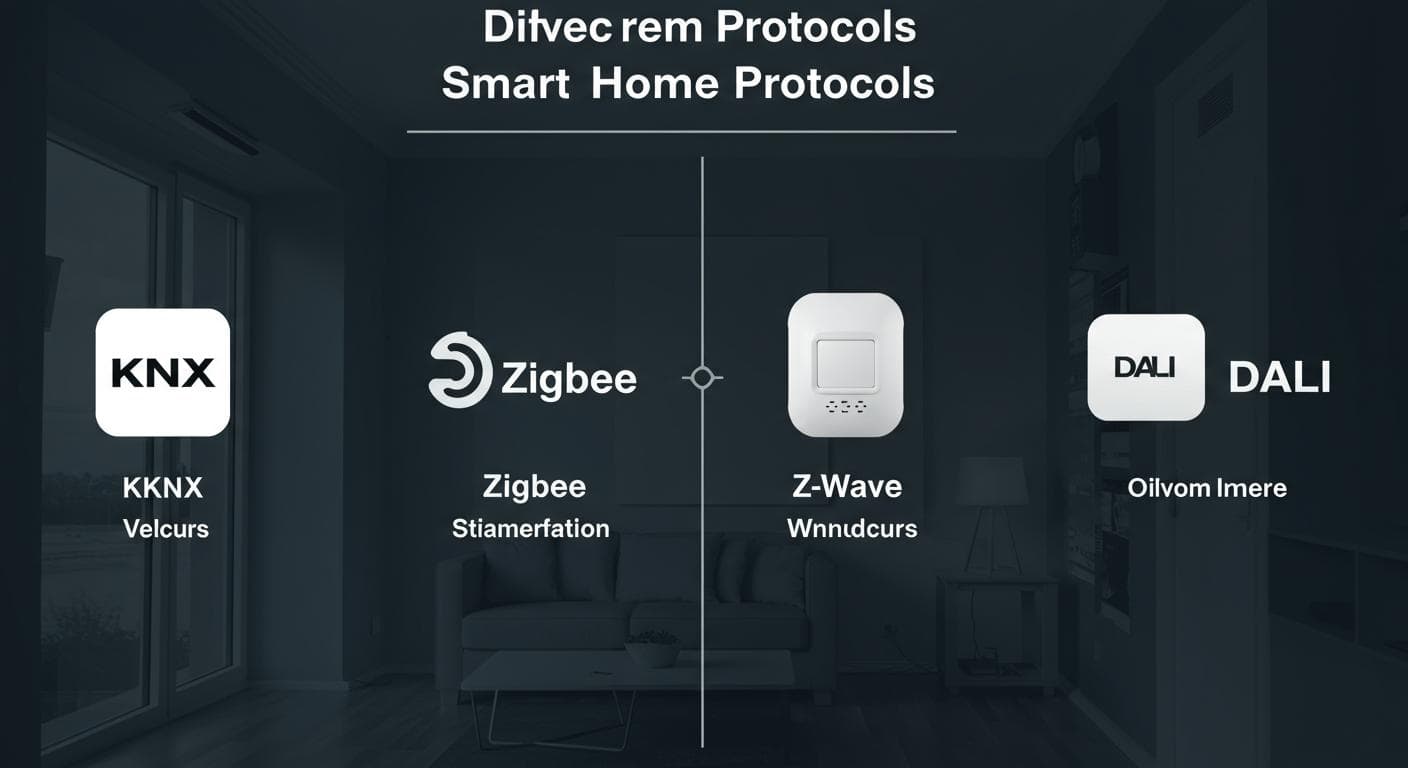
The smart home revolution: wired or wireless?
Smart home is revolutionising our living spaces, but faced with the multitude of technologies available, how do you choose between wired and wireless solutions? This crucial technical question determines the reliability, security and longevity of your smart home installation.
KNX, the worldwide standard for wired smart home, stands against wireless technologies such as Zigbee, Z-Wave or WiFi IoT. Our comparative analysis examines every aspect: transmission reliability, data security, technical scalability, operating costs and ease of maintenance.
Key comparison points
- Reliability: Data transmission and system availability
- Security: Protection against intrusion and interception
- Scalability: Extension and update capability
- Costs: Initial investment and long-term operation
Wired technologies: KNX excellence
Architecture and operating principle
KNX uses dedicated cabling (bus) for communication between all smart home components. This wired infrastructure guarantees perfectly stable data transmission, without external interference. Each device has a unique address on the bus, enabling reliable bidirectional communication.
The KNX protocol operates on a free topology: line, star, tree or hybrid. This architectural flexibility adapts to all types of buildings, from single-family homes to large commercial complexes.
Technical advantages of wired KNX
Maximum reliability
- • Direct cable transmission
- • No radio interference
- • Availability > 99.9%
- • Stable integrated power supply
Constant performance
- • Ultra-low latency
- • Dedicated bandwidth
- • No network congestion
- • 24/7 operation
Wireless technologies: market overview
Main wireless technologies
The wireless market offers several protocols: Zigbee 3.0, Z-Wave Plus, WiFi IoT, Thread/Matter, and proprietary solutions. Each technology has technical specificities and limitations inherent to radio transmission.
Common wireless technologies
Zigbee 3.0
2.4GHz mesh, limited range, WiFi interference
Z-Wave Plus
868MHz frequency, mesh, 232-node limit
WiFi IoT
Existing infrastructure, high consumption
Thread/Matter
Emerging standard, maturity in development
Intrinsic limits of wireless
Wireless technologies are subject to unavoidable physical constraints: limited radio propagation, electromagnetic interference, architectural obstacles, and energy consumption of components. These factors directly impact the reliability and maintenance of installations.
Detailed comparison: reliability and availability
Transmission reliability
| Criterion | Wired KNX | Zigbee | Z-Wave | WiFi IoT |
|---|---|---|---|---|
| Availability rate | 99.9% | 95-98% | 96-98% | 90-95% |
| Average latency | < 100ms | 200-500ms | 300-800ms | 500-2000ms |
| Interference | None | WiFi, Bluetooth | Limited | Multiple |
| Power supply | Integrated bus | Batteries | Batteries | Mains |
Analysis of KNX reliability
Wired KNX demonstrates exceptional reliability thanks to several technical factors:
- Deterministic communication: Transmission guaranteed without data loss
- Electromagnetic immunity: Shielded cabling resistant to interference
- Stable power supply: Integrated 29V bus, no battery dependence
- Advanced diagnostics: Preventive and corrective maintenance tools
Security: the decisive advantage of wired
Vulnerabilities of wireless systems
Wireless technologies present security vulnerabilities inherent to their radio nature. Interception, jamming, or data injection attacks remain possible despite encryption in place. These risks increase with the proliferation of connected objects.
Wireless security risks
- • Radio interception: Capture of communications by third parties
- • Denial of service attacks: Intentional jamming of frequencies
- • Key compromise: Exploitation of cryptographic weaknesses
- • Proximity attacks: Exploitation from outside the building
Enhanced security of wired KNX
Wired KNX offers incomparable intrinsic security. Physical access to the cabling is necessary for any intrusion attempt, drastically limiting attack vectors. This architecture guarantees an optimal security level for critical installations.
KNX security advantages
- • No radio emissions: No remote interception possible
- • Physical access required: Building perimeter security
- • Optional bus encryption: Additional protection available
- • Facilitated security audit: Closed and controllable infrastructure
Scalability and technological longevity
Scalability of KNX systems
The KNX architecture guarantees exceptional scalability thanks to its modular design and open standard. Adding new functionality is done without impact on the existing installation, preserving your investment over the long term.
Technical scalability
- • Simplified modular extension
- • Guaranteed interoperability
- • Centralised firmware update
- • Reconfiguration without rewiring
Economic longevity
- • Standard stable for 30+ years
- • 500+ certified manufacturers
- • No planned obsolescence
- • Sustainable property valuation
Wireless scalability limits
Wireless technologies are subject to faster obsolescence cycles. Protocol updates, frequency changes, or standard evolutions can render equipment incompatible, requiring costly replacements.
Cost analysis: comparative TCO
Total cost of ownership (TCO)
The analysis of total cost of ownership reveals a significant advantage for wired KNX over 15-20 years. Despite a higher initial investment, operating savings largely compensate for this difference.
| Cost item | Wired KNX | Wireless average |
|---|---|---|
| Initial investment | 100% (reference) | 60-80% |
| Annual maintenance | 1-2% | 5-8% |
| Battery replacement | €0 | €200-500/year |
| Obsolescence (10 years) | Partial | Total |
| TCO 15 years | 120-130% | 180-220% |
KNX economy factors
- Preventive maintenance: Advanced diagnostics reducing failures
- Extended lifespan: 20+ years vs 5-10 years for wireless
- No consumables: No batteries to replace
- Economic scalability: Extensions without complete replacement
Expert technical advice: which solution to choose?
Wired KNX: recommended use cases
Prioritise wired KNX for:
- • New builds: Optimal integration from design
- • Heavy renovations: Complete electrical installation overhaul
- • Commercial buildings: Critical reliability and security
- • Complex installations: Numerous devices and automation
- • Security requirements: Sensitive data or strict regulations
Hybrid solutions: the best of both worlds
In certain contexts, a hybrid approach can optimise the cost/performance ratio. Wired KNX for critical infrastructure (heating, main lighting, security) and wireless technologies for one-off extensions or mobile equipment.
Our technical recommendation
For a reliable, secure and lasting smart home installation, wired KNX is the optimal choice. The higher initial investment is compensated by significant operating savings and sustainable property added value.
Each project being unique, our personalised technical audit determines the optimal solution according to your architectural, budgetary and functional constraints.
FAQ: Wired vs wireless smart home
What is the main difference between wired and wireless smart home?
Wired smart home like KNX uses dedicated cables for communication, guaranteeing stable and secure transmission. Wireless smart home (Zigbee, Z-Wave, WiFi) uses radio waves, but can experience interference and requires battery power for some components.
Why is wired KNX more reliable than wireless solutions?
Wired KNX offers direct cable communication without radio interference, stable power supply with no batteries to change, and total immunity to electromagnetic disturbances. The availability rate is above 99.9%.
Is the wired KNX system more secure?
Yes, wired KNX is intrinsically more secure because it does not emit interceptable radio waves. Physical access to the cabling is necessary for any intrusion, unlike wireless systems vulnerable to wave attacks.
What are the long-term costs between wired and wireless?
Although the initial investment is higher for wired KNX, long-term costs are lower: no battery replacement, reduced maintenance, 20+ year lifespan, and scalability without technological obsolescence.
Is wired KNX suitable for renovation?
Wired KNX is ideal for major renovations and new builds. For light renovations, our technical audit determines feasibility and proposes hybrid solutions if necessary.
Conclusion: Wired KNX, technical excellence
This comparative analysis demonstrates the technical superiority of wired KNX for demanding smart home installations. Maximum reliability, enhanced security, guaranteed scalability and optimised operating costs position KNX as the technological reference.
Investing in wired KNX infrastructure secures your project in the long term, offering a scalable and sustainable technical platform for your smart home.
Personalised technical audit
Our experts analyse your project to determine the optimal smart home solution: technical feasibility, budget estimation and personalised recommendations.
About the author

KNX Solutions Luxembourg
KNX technical team
Written by the technical team at KNX Solutions Luxembourg, an engineering office specialising in ETS programming and KNX integration in the Grand Duchy.
Contents
Related articles
Smart home project in sight?
Discover which technology best suits your project. Free technical audit and personalised quote.
Get a quoteRecommended articles
KNX installation price Luxembourg 2025
Complete guide to KNX rates: material costs, labour, and factors influencing your smart home budget in Luxembourg.
Read more
Securing your home with KNX
KNX security solutions: integrated alarm, presence simulation, intrusion detection. Optimal protection of your home.
Read more
Choosing your KNX integrator
Essential criteria for selecting your KNX integrator: certifications, experience, references and guarantees.
Read more