
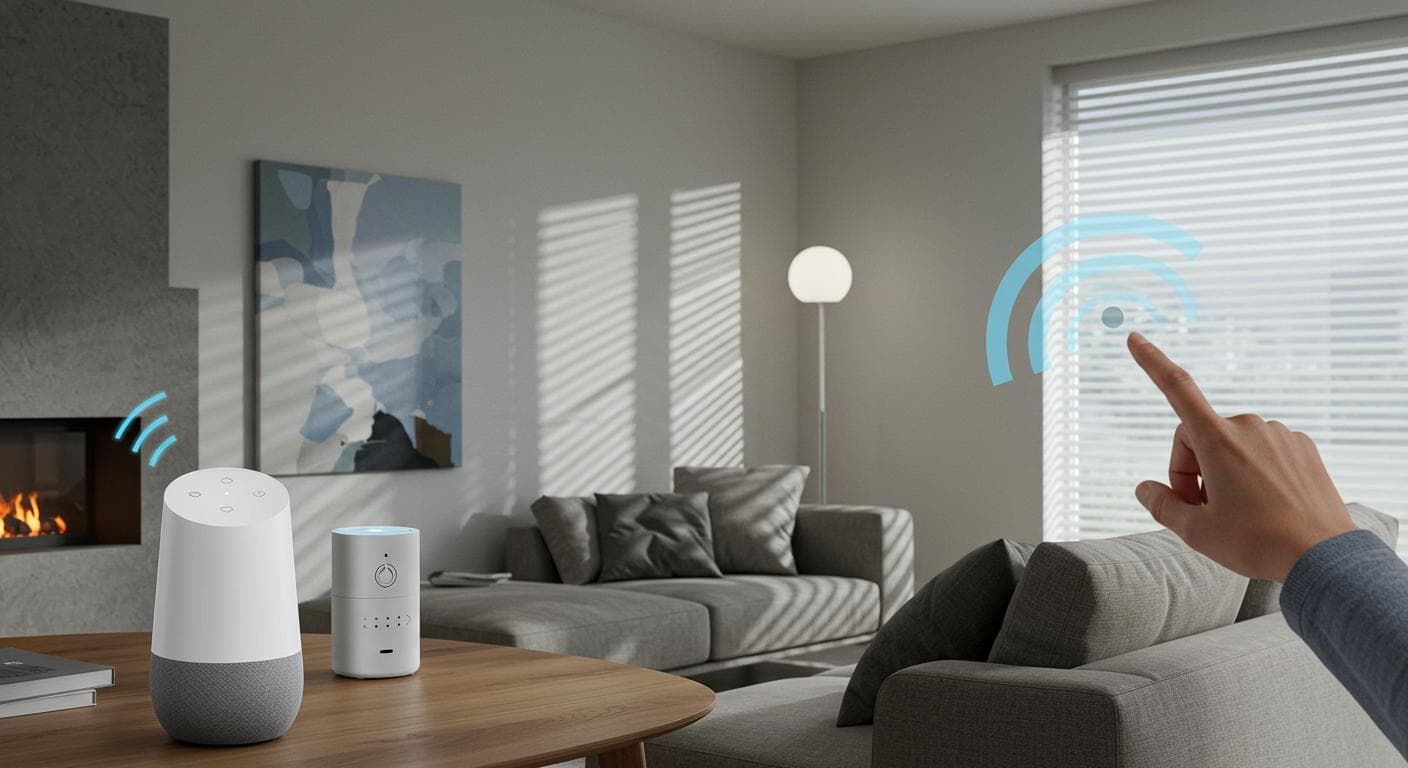
How to automate your lighting with KNX?
Turn your lighting into a smart system: presence detectors, automatic scenes, energy savings of up to 60%. Complete guide for residential and commercial properties.

Why automate your lighting with KNX?
Lighting accounts on average for 15% of your energy bill. With KNX automation, you can reduce this consumption by 40 to 60% while significantly improving your daily comfort. KNX, the global building automation standard, offers particularly sophisticated and reliable lighting automation solutions.
Unlike traditional lighting systems, KNX automation provides centralised, intelligent and adaptive management of every light point. Whether you own a home or manage an office or shop, the benefits are immediate and lasting.
Key figures for lighting automation
- • 40-60% savings on your lighting bill
- • Return on investment in 3-5 years
- • LED lifespan extended by 30% thanks to dimming
- • CO2 reduction of 2-4 tonnes per year for a home
The benefits of KNX lighting automation
1. Substantial energy savings
KNX automation optimises your lighting consumption thanks to several innovative technologies:
- Smart presence detection: Lighting only operates when needed, eliminating up to 30% of energy waste.
- Automatic light regulation: Brightness sensors adjust intensity based on available daylight, saving 25-40% of energy.
- Sophisticated time schedules: Automatic shutdown at end of day, night standby lighting, seasonal adaptation.
- Intelligent dimming: Extends LED lifespan by 30% while cutting consumption.
2. Optimised comfort and wellbeing
KNX automation transforms your relationship with lighting by creating atmospheres perfectly matched to each moment:
- Automatic on and off: No more searching for the switch — lighting adapts to your presence.
- Personalised light intensity: Soft in the morning, bright for work, dimmed in the evening.
- Ambience scenes: A single button changes the atmosphere of your rooms (reading, dining, TV, entertaining).
- Circadian synchronisation: Lighting follows your natural biological rhythm to improve sleep and wellbeing.
Example of a typical day with KNX automation
KNX automation technical solutions
1. KNX presence and motion detectors
Presence detectors form the heart of lighting automation. KNX offers different types suited to each use:
PIR detectors (Passive Infrared)
- • Ideal for corridors, stairs, WCs
- • Range: 6-12 metres
- • Savings: 30-50%
- • Price: 80-150€ per detector
HF detectors (High Frequency)
- • Perfect for offices, open-plan spaces
- • Fine motion detection
- • Savings: 40-60%
- • Price: 120-250€ per detector
Combined PIR + HF detectors
- • Living rooms, bedrooms, large rooms
- • Maximum reliability
- • Savings: 45-65%
- • Price: 200-350€ per detector
Outdoor detectors
- • Terraces, gardens, car parks
- • Weather-resistant
- • Savings: 60-80%
- • Price: 150-400€ per detector
2. Brightness sensors and automatic regulation
KNX brightness sensors measure available daylight and automatically adjust artificial lighting. This technology enables:
- Constant lighting level maintenance: 500 lux for an office, 300 lux for a living room, adapted to each activity.
- Daylight compensation: More sun = less artificial lighting, automatic savings.
- Seasonal adaptation: The system learns and adapts to brightness variations across seasons.
- Smart zoning: Each zone can have its own settings based on orientation and use.
3. KNX dimmers and lighting modules
KNX dimmers provide precise control of light intensity and offer advanced features:
- Smooth 0-100% dimming: Precise intensity control for all lamp types (LED, halogen, fluorescent).
- Scene memory: Up to 64 different scenes per module.
- Customised dimming curves: Gradual switch-on and off for visual comfort.
- Lamp protection: Soft start that extends LED lifespan.
Automatic lighting scenes
Residential scenes
In a home, KNX automation creates personalised scenes for every moment of life:
☀"Progressive wake-up" scene
- • Gentle switch-on over 15-30 minutes (sunrise simulation)
- • Progressive intensity from 1% to 80%
- • Sync with blinds and heating
- • Weekend / weekday adaptation
🏠"Welcome home" scene
- • Arrival detection (smartphone, badge, schedule)
- • Sequential switch-on: entrance → hallway → living room
- • Adapted to outdoor brightness
- • Conditional activation (only when needed)
🎬"Movie night" scene
- • Main lighting switched off
- • Indirect lighting activated at 20%
- • Electronic standby automatic
- • Gentle reactivation at film's end
🌙"Night mode" scene
- • Automatic hallway nightlights (5% intensity)
- • Walk-through detection for temporary lighting
- • Red/orange light to protect sleep
- • Automatic shutdown after passing
Tertiary and commercial scenes
For offices, shops and tertiary buildings, KNX offers particularly sophisticated automation solutions:
💼Smart office
- • Zone management: open plan, individual offices, meeting rooms
- • Comfort lighting: 500 lux at workstations, 300 lux in circulation
- • Fine per-desk occupancy detection
- • Average savings: 50-70% vs traditional lighting
🏪Retail and shops
- • Ambient lighting based on time and footfall
- • Product highlighting with directed lighting
- • Savings outside opening hours: 80-90%
- • Compliance with safety lighting standards
🎓Educational facilities
- • Automatic adaptation to teaching activities
- • Comfort lighting for learning (750 lux at boards)
- • Automatic school holiday management
- • Enhanced safety with integrated emergency lighting
Energy savings: calculations and return on investment
Calculating potential savings
Energy savings with KNX automation are measurable and significant. Here are typical calculations by building type:
Concrete example: 150m² house in Luxembourg
Before automation:
- • Lighting consumption: 3,500 kWh/year
- • Electricity cost: 0.25€/kWh
- • Annual bill: 875€
- • Estimated waste: 40-50%
With KNX automation:
- • Optimised consumption: 1,750 kWh/year
- • Energy savings: 50%
- • New bill: 438€/year
- • Savings: 437€/year
Savings factors by installation type
| Building type | Detection savings | Dimming savings | Total savings | Average ROI |
|---|---|---|---|---|
| 80m² flat | 25-35% | 15-25% | 40-50% | 3-4 years |
| 150m² house | 30-40% | 20-30% | 45-60% | 4-5 years |
| 200m² office | 40-50% | 25-35% | 55-70% | 3-4 years |
| 300m² shop | 50-60% | 20-30% | 60-75% | 2-3 years |
Installation and deployment
Installation in new build
Installing a KNX lighting automation system in a new build offers maximum flexibility and optimisation:
- Optimal planning: Integration from electrical design stage, optimal positioning of detectors and sensors.
- Dedicated KNX bus cabling: KNX bus installed alongside the electrical network for optimal communication.
- Optimised cost: No renovation surcharge, integrated into construction budget.
- Maximum scalability: Prepared for future extensions (blinds, heating, security).
Automation in renovation
Thanks to KNX innovations, lighting automation is now possible even in renovations without major works:
- KNX Radio (RF) solutions: Wireless communication, installation without bus cabling.
- Flush-mounted micromodules: Installed behind existing switches, maximum compatibility.
- Wireless detectors: Wall or ceiling mounted, long-life battery powered.
- Progressive integration: Room-by-room automation based on budget and priorities.
Typical installation steps
- 1. Energy audit: Analysis of current consumption and savings potential
- 2. Technical study: Choice of detectors, dimmers and scenes by use
- 3. Detailed quote: Precise estimate with ROI and expected benefits
- 4. Professional installation: Deployment by certified KNX integrator
- 5. Programming and tests: Scene configuration and operation validation
- 6. User training: Handover and parameter optimisation
Budgets and prices for lighting automation
Cost estimates by project type
KNX lighting automation prices vary by complexity and project size. Here are price ranges in Luxembourg:
Residential – 80m² flat
- • Presence detectors (6 rooms): 900-1 500€
- • KNX dimmers (12 circuits): 1 200-2 000€
- • Installation and programming: 800-1 200€
- Total: 2,900-4,700€
- Annual savings: 200-350€
Residential – 150m² house
- • Detectors and sensors (15 zones): 2 500-4 000€
- • Dimmers and modules (25 circuits): 3 000-5 000€
- • Complete installation: 2 500-4 000€
- Total: 8,000-13,000€
- Annual savings: 400-650€
Tertiary – 200m² office
- • Advanced detection system: 4 000-7 000€
- • Dimming and zone management: 6 000-10 000€
- • Installation and commissioning: 5 000-8 000€
- Total: 15,000-25,000€
- Annual savings: 1,500-3,000€
Commercial – 300m² shop
- • Detection and smart lighting: 8 000-12 000€
- • Zone and window dimming: 10 000-15 000€
- • Professional installation: 7 000-10 000€
- Total: 25,000-37,000€
- Annual savings: 3,000-5,500€
Available financing and grants
In Luxembourg, several schemes can help you fund your lighting automation project:
- PRIMe House: Energy efficiency subsidies, up to 30% of cost for certain equipment.
- Tax deductions: Sustainable development tax credit for energy-saving building automation.
- Climate loans: Favourable financing for energy improvement projects.
- Energy savings certificates: Valuing the savings achieved.
Real installation examples
🏠Client case: 4-bedroom villa in Hesperange
Challenge:
- • High electricity bill (2,400€/year)
- • Lighting often left on
- • House empty 8h/day
- • Need for comfort and security
KNX solution installed:
- • 18 presence detectors
- • 32 LED dimmers
- • 8 brightness sensors
- • Automatic scenes
🏢Client case: 180m² law firm in Luxembourg City
Challenge:
- • Permanent open-space lighting
- • Energy costs: 1,800€/year
- • Often-empty meeting rooms
- • Need for professional lighting standards
KNX solution installed:
- • Per-workstation detection
- • Automatic 500 lux regulation
- • Weekend/holiday management
- • Integrated safety lighting
FAQ – Frequently asked questions
QCombien peut-on économiser avec un éclairage automatisé KNX ?
QLes détecteurs de présence KNX fonctionnent-ils dans toutes les pièces ?
QPeut-on programmer des scénarios d'éclairage complexes avec KNX ?
QL'automatisation KNX est-elle adaptée aux bureaux et commerces ?
QCombien coûte l'automatisation de l'éclairage KNX ?
QPeut-on automatiser l'éclairage dans une maison existante ?
Conclusion: Switch to smart lighting
KNX lighting automation is a smart investment combining energy savings, optimal comfort and property value. With 40 to 60% savings on your lighting bill and a return on investment in 3-5 years, it's a financially sound decision.
Beyond the economic aspect, KNX automation transforms your relationship with lighting: no more forgotten switches — just lighting that automatically adapts to your needs and improves your daily quality of life.
Whether you are a private individual or a professional in Luxembourg, our KNX experts support you in delivering your lighting automation project, from energy audit to commissioning.
Ready to automate your lighting?
Get your personalised quote and discover your potential savings. Free, no-obligation energy audit.
⭐ +15 years of experience | 🏆 KNX Specialist | 📞 Technical support included
About the author

KNX Solutions Luxembourg
KNX technical team
Written by the technical team at KNX Solutions Luxembourg, an engineering office specialising in ETS programming and KNX integration in the Grand Duchy.
Savings calculator
Similar articles
Need help with your project?
Our lighting automation experts support you from energy audit to final installation.
Free quoteRecommended articles

KNX installation prices Luxembourg 2025
Complete guide to KNX rates in Luxembourg: installation, equipment, labour. Detailed budgets by project type.
Read more
Energy savings with KNX home automation
Discover how to reduce your energy bill by 30-50% thanks to intelligent KNX automation of your home.
Read more
How to choose the right KNX products
Expert guide to selecting KNX equipment suited to your project: detectors, actuators, interfaces.
Read more