
How to choose the right KNX products for your project
A complete guide to help you select the KNX products best suited to your needs and budget.
Introduction to selecting KNX products
KNX technology offers unmatched flexibility and interoperability in building automation. With more than 500 certified manufacturers and thousands of compatible products, the possibilities are almost endless. However, this abundance of choice can also become a challenge: how do you select the products that will perfectly meet your needs, your budget and the specifics of your project?
Whether you are a homeowner looking to automate your home, an architect integrating automation into your designs, or an installer seeking to optimise your recommendations, this guide will help you navigate the KNX ecosystem and make informed decisions.
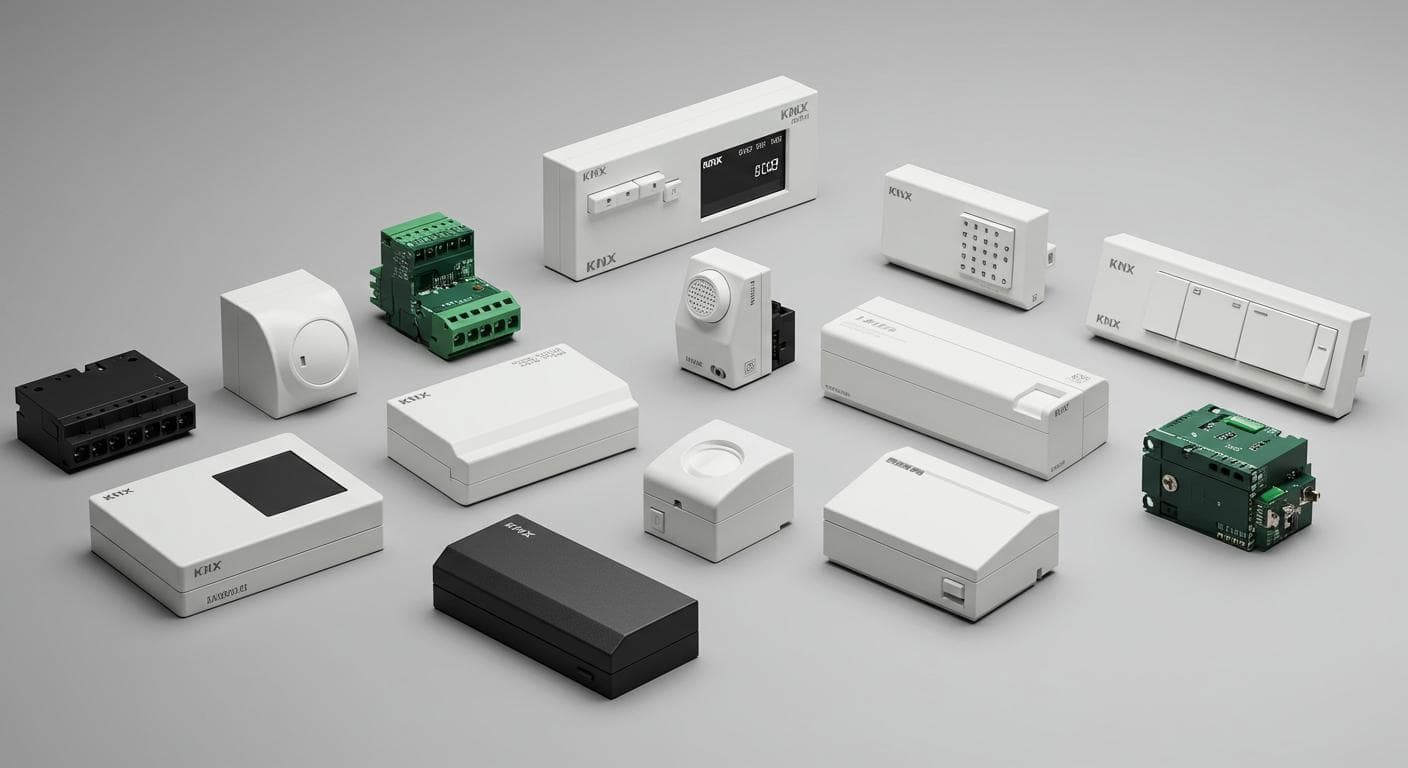
Understanding the different categories of KNX products
1. System components
System components form the backbone of any KNX installation. They ensure communication between the various devices and the proper operation of the entire system.
- Bus power supply : Provides the energy needed to operate the KNX bus. The choice of rating depends on the number of devices to be powered.
- Line/area couplers : Allow the installation to be segmented into several lines or areas to optimise performance and reliability.
- USB/IP interfaces : Provide the connection between the KNX system and a computer for programming and supervision.
- IP routers : Enable communication between different KNX installations over an IP network.
Expert tip
For a standard residential installation, plan for a 640 mA power supply for each line of up to 64 devices. For larger projects, consider segmenting your installation into several lines to ensure stability and ease of maintenance.
2. Sensors and user interfaces
Sensors and user interfaces are the elements occupants interact with directly. They enable the system to be controlled and gather information about the environment.
- Push-buttons : From a simple button to a multifunction keypad with display, they control lighting, blinds, temperature and more.
- Touch screens : Offer a complete graphical interface to control the entire system.
- Presence/motion detectors : Detect the presence or movement of occupants to automate lighting, ventilation and more.
- Temperature, brightness, CO2 sensors, etc. : Measure various environmental parameters to automatically adapt the system's behaviour.
- Weather stations : Provide meteorological data to optimise energy management and comfort.
3. Actuators
Actuators are the components that carry out the actions commanded by sensors or user interfaces. They directly control the equipment in the home or building.
- Lighting actuators : Switch luminaires on and off or vary their intensity.
- Blind/shutter actuators : Control the position of blinds, shutters or curtains.
- Heating/air-conditioning actuators : Regulate the temperature of different zones.
- Multifunction actuators : Combine several functions in a single device to optimise space in the electrical panel.
Actuator selection criteria
- Number of channels : Match the number of channels to your current and future needs to avoid multiplying devices.
- Power rating : Check that the power supported per channel is compatible with your equipment.
- Advanced features : Some actuators offer energy metering, built-in scenes or logic functions.
4. Gateways and interfaces
Gateways and interfaces make it possible to integrate third-party systems or protocols into the KNX ecosystem, extending the possibilities of your installation.
- DALI gateways : For the integration of DALI lighting systems.
- Audio/video gateways : For the control of multimedia systems.
- Interfaces for voice assistants : For voice control via Google Home, Amazon Alexa or Apple HomeKit.
- IoT gateways : For the integration of connected devices.
Methodology for choosing the right products
1. Define your needs precisely
The first and probably most important step is to clearly define your needs and expectations. Ask yourself the following questions:
- Which functions do you want to automate? (lighting, heating, blinds, security, etc.)
- What level of comfort are you looking for? (simple control, complex scenes, advanced automation)
- What are your goals regarding energy savings?
- Do you have specific constraints? (listed building, partial renovation, etc.)
- Are you planning future extensions to your system?
2. Set a realistic budget
Budget is often a deciding factor in product selection. It is important to set a realistic budget by taking several elements into account:
- Prioritise your needs : Distinguish essential from desirable in order to allocate your budget accordingly.
- Think about the total cost : Include not only the cost of the products, but also installation, programming and maintenance.
- Consider a phased approach : If your budget is limited, plan an installation in phases, but with a coherent overall architecture.
Typical budget breakdown
For a standard residential project, the typical budget breakdown is as follows:
- 50-60% : KNX products (actuators, sensors, interfaces, etc.)
- 30-40% : Installation and cabling
- 10-20% : Programming and commissioning
3. Choose quality manufacturers
All KNX-certified products are interoperable, but they can differ in quality, reliability, features and design. Here are some criteria for choosing the right manufacturers:
- Reputation and experience : Favour established manufacturers with solid experience in the KNX field.
- Technical support : Ensure that the manufacturer offers good technical support, ideally in your language and time zone.
- Product availability : Check that products are readily available in your region to avoid supply delays.
- Warranty and after-sales service : Find out about warranty conditions and after-sales service.
4. Consider scalability and longevity
A home automation system is a long-term investment. It is therefore essential to choose products that guarantee the scalability and longevity of your installation:
- Scalability : Opt for an architecture that makes it easy to add new features in the future.
- Updates : Check that the manufacturer regularly provides updates for its products.
- Backward compatibility : Ensure that new products will be compatible with your existing installation.
Recommendations by project type
1. Residential project
For a detached house or apartment, here are the essential KNX products to consider:
- Lighting : Lighting actuators, dimmers, presence and brightness sensors.
- Heating/air-conditioning : Thermostats, heating actuators, temperature probes.
- Blinds/shutters : Blind actuators, weather station, brightness sensors.
- User interfaces : Push-buttons in every room, central touch screen, smartphone/tablet interface.
- Security : Integration with the alarm system, presence simulation, water or gas leak detection.
2. Commercial project
For an office, a shop or a hotel, priorities are often different:
- Energy management : Consumption monitoring, automatic optimisation, load shedding.
- Occupant comfort : Precise regulation of temperature and lighting, air quality.
- Access control : Integration with access control and security systems.
- Supervision : Centralised visualisation and building management system.
3. Renovation project
In a renovation, where wiring options may be limited, favour:
- Wireless solutions : KNX RF (Radio Frequency) products to avoid cabling work.
- Decentralised actuators : Designed to be installed directly in flush-mounted boxes.
- Hybrid solutions : Combining wired KNX for new installations with KNX RF for the existing building.
Common mistakes to avoid
Finally, here are some common mistakes to avoid when choosing KNX products:
- Under-sizing the installation : Always leave a margin for future developments.
- Sacrificing quality for price : Short-term savings can turn into additional long-term costs.
- Ignoring the user experience : Interfaces must be intuitive and suited to end users.
- Forgetting documentation : Complete documentation is essential for maintenance and future developments.
Conclusion
Choosing the right KNX products for your project is a crucial step that will largely determine the success of your home automation installation. By following a rigorous methodology, clearly defining your needs and relying on expert advice, you can create a system perfectly suited to your expectations and budget.
Remember that the quality of the installation and programming is just as important as that of the products. Call on KNX-certified professionals to ensure the optimal implementation of your project.
At KNX Solutions, we support you at every stage of your project, from product selection to commissioning, including installation and programming. Feel free to contact us to benefit from our expertise.
About the author

KNX Solutions Luxembourg
KNX technical team
Written by the technical team at KNX Solutions Luxembourg, an engineering office specialising in ETS programming and KNX integration in the Grand Duchy.
Related articles
Need advice for your project?
Our experts are available to help you choose the KNX products best suited to your project.
Contact usRecommended articles
The benefits of KNX for smart homes
Discover how KNX technology can transform your home into an intelligent, energy-efficient and comfortable space.
Read more
KNX vs. other home automation protocols: a comparison
Comparative analysis between KNX and other home automation protocols such as Zigbee, Z-Wave and DALI.
Read more
KNX highlights in 2023
Discover the latest innovations and trends in the KNX world for this year.
Read more