Energy Savings with KNX: How a Villa Reduced Its Consumption by 40%
Detailed case study of a 200m² villa in Luxembourg: energy monitoring, sub-metering per circuit, before/after audit and concrete results. Discover how KNX saved 4,800 kWh per year.
Key Results of the Study
Project Context
This case study presents the concrete results of a KNX installation in a 200m² villa located in Strassen (Luxembourg). The owner wanted to reduce their energy bill while improving daily comfort.
Home Characteristics
Building
- • Living area: 200m²
- • Construction: 2005
- • Insulation: Standard RT2005
- • Number of rooms: 8
Existing Equipment
- • Heating: Air/water heat pump
- • DHW: Thermodynamic cylinder
- • Lighting: LED + halogen
- • Blinds: motorised but not automated
Initial Energy Audit
Before the KNX installation, we conducted a complete energy audit with temporary sub-meters installed for 3 months to establish a precise reference baseline.
Consumption Before KNX
Annual Consumption Breakdown: 12,000 kWh
| Item | kWh/year | Share |
|---|---|---|
| Heating/Air conditioning | 5,400 | 45% |
| Domestic hot water | 2,400 | 20% |
| Lighting | 1,800 | 15% |
| Appliances | 1,440 | 12% |
| Standby and misc. | 960 | 8% |
KNX Installation Carried Out
Installed Components
8 thermal zones with sensors
24 circuits with dimming and presence
12 blinds with solar scenarios
6 permanent KNX sub-meters
Automatic adaptation to conditions
Detectors + smartphone geolocation
Installation Budget
Investment Details
- • KNX equipment: €8,500
- • Energy sub-meters: €1,200
- • Installation and cabling: €3,800
- • ETS programming: €2,500
- • Total: €16,000
Results After 18 Months
Savings by Consumption Item
| Item | Before | After | Savings |
|---|---|---|---|
| Heating/AC | 5,400 kWh | 3,510 kWh | -35% |
| Lighting | 1,800 kWh | 720 kWh | -60% |
| Standby/misc. | 960 kWh | 192 kWh | -80% |
| DHW | 2,400 kWh | 2,160 kWh | -10% |
| Appliances | 1,440 kWh | 1,368 kWh | -5% |
| TOTAL | 12,000 kWh | 7,200 kWh | -40% |
Gain Analysis by Feature
Heating (-35%)
- • Zoning: -15% (unoccupied rooms)
- • Scheduling: -10% (night/absence)
- • Solar blinds: -7% (free solar gains)
- • Open windows: -3% (auto cut-off)
Lighting (-60%)
- • Presence detection: -30% (auto switch-off)
- • Dimming: -15% (adapted light)
- • Natural light: -10% (lux sensor)
- • Scenarios: -5% (all off)
Return on Investment Calculation
Detailed ROI
Note: With energy price increases (+15% in 2023), the real ROI could drop to 3.5 years.
Monitoring and Continuous Follow-up
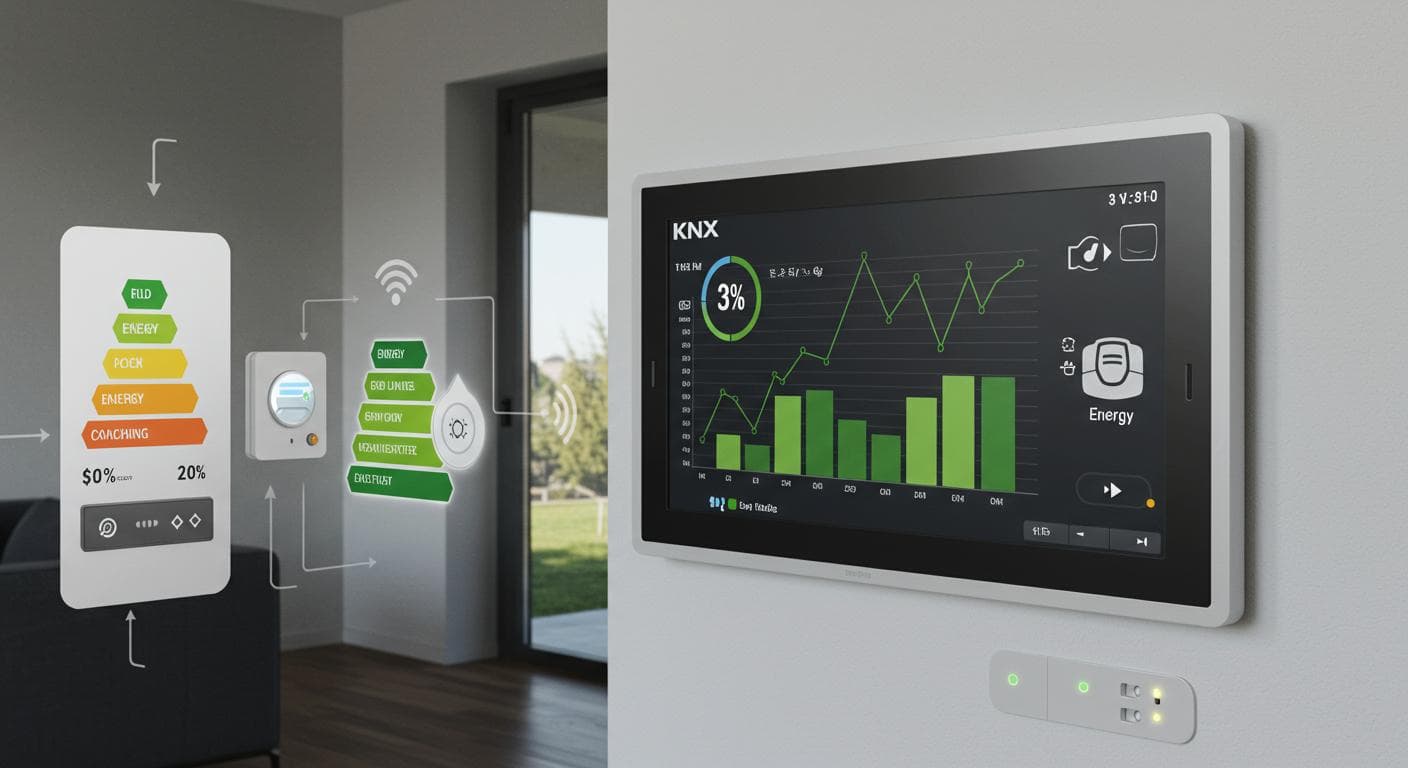
The installation includes a permanent energy monitoring system that enables the owner to:
- Visualise real-time consumption per circuit
- Compare consumption month by month, year by year
- Detect anomalies (unusual overconsumption)
- Optimise behaviour via personalised alerts
Frequently Asked Questions (FAQ)
What energy savings can you realistically expect with KNX?
Savings vary from 25% to 45% depending on configuration. Our case study demonstrates a 40% reduction on a 200m² villa, around 4,800 kWh/year saved.
What is the return on investment of a KNX installation?
Typical ROI is 3 to 6 years depending on installation size and energy rates. Our case study shows a 4.2-year ROI with 2023 Luxembourg rates.
How does KNX enable consumption monitoring?
KNX integrates electrical sub-meters per circuit, power sensors and supervision interfaces that enable real-time monitoring and detailed history.
Which consumption items are most impacted by KNX?
Lighting (-60%), heating (-35%) and electrical standby (-80%) are the items where KNX generates the most savings thanks to intelligent automation.
Conclusion
This case study concretely demonstrates the savings potential of a well-designed KNX installation. With a 40% reduction in energy consumption and a 4.2-year ROI, investing in KNX smart home is not only profitable but also beneficial for the environment.
Assess your savings potential
Our experts carry out a free energy audit of your home to estimate your potential savings with KNX.
Request a free auditAbout the author
KNX Solutions Luxembourg
KNX technical team
Written by the technical team at KNX Solutions Luxembourg, an engineering office specialising in ETS programming and KNX integration in the Grand Duchy.
Related articles
Recommended articles